

Sir Rocco Forte has seen a few things in his life. As a man now in his late eighties—born in Britain to an Italian father—he carries the long arc of European hospitality in his bones. He grew up inside one of the continent’s great hotel dynasties, worked his way from the ground up, and became an emblem of British hospitality, knighted by Queen Elizabeth II for his contributions to the industry. And then, in the 1990s, he lost the entire family empire in the crushing blow of a hostile takeover.
Many executives would have stepped aside at that point. Some might have accepted it as the natural end to a long career. Forte was in his fifties, old enough to retire gracefully and certainly entitled to do so. But he didn’t. He began again.
The next chapter became Rocco Forte Hotels. He built it on a sensibility he formed in childhood from working with his father and on the gift of his two cultural inheritances. “I always had the best of both worlds,” he says. The Italian side made hospitality instinctive—warm, embracing, a form of social intuition. The British side gave him rigor, discipline, and an understanding that service is a form of dignity.
That duality is the foundation of his life’s work.

Maintaining a Sense of Place
In the modern luxury landscape, sameness has become increasingly common. Guests are trained to expect uniformity: identical lobbies, identical patterns, identical experiences. The global industry has leaned heavily into predictability, smoothing out cultural particularities in the name of consistency.
Forte’s hotels reject that.
“Each hotel should have an individual personality that reflects its location,” he insists. The connecting thread is not décor or aesthetic but service—“simple, comfortable and straightforward,” grounded in warmth and attention rather than theatrics.
It’s not branding—it’s philosophy. His properties belong to their cities rather than conform to a corporate identity. In an era when luxury is engineered for replication, his insistence on context is quietly radical.

Inheritance, Interruption, and the Work of Rebuilding
The fall of the original Forte Group was both public and personal—a dismantling of a dynasty built by his father, Lord Charles Forte. But when Rocco Forte speaks of that era now, he doesn’t focus on loss. He focuses on what survived.
“For my father, integrity was very important . . . how you treated staff, suppliers, customers,” he says. “He always had time for people.” When he and his sister, Olga Polizzi, founded Rocco Forte Hotels, those fundamentals stayed the same.
He began learning the ropes at the old Forte Group at the age of fourteen. Those early jobs grounded him in the mechanics of the business and shaped the way he guided his own children. Charles, Lydia, and Irene entered the company the same way: early exposure, hands-on roles, no shortcuts. “They took to it like a duck to water,” he says, with reserved but unmistakable pride.

The Properties as Cultural Landmarks
What stands out in his 15-property portfolio is how often his asset choices have involved historic preservation. The hotels, resorts, residences, and villas are located in some of the world’s great capitals, many housed in magnificent landmark buildings such as the Hotel Astoria in St. Petersburg and the Hotel Savoy in Florence. But across the collection, the unifying thread is not architecture but worldview: local identity, intuitive service, and a belief that elegance thrives in restraint.
“Guests don’t want to stay in an amorphous chain hotel and have exactly the same experience wherever they are in the world,” he says. “They want to gain a sense of place, try local flavors when they dine, and absorb the personality of the city where they’re staying.” Authenticity and individuality, in his view, are more important than ever.
A few properties illustrate this worldview clearly:

Brown’s Hotel — London
Founded in 1837, Brown’s is one of the archetypes of English luxury. Queen Victoria was known to visit for tea. Rudyard Kipling wrote The Jungle Book while staying there, and the Kipling Suite still commemorates that work. Brown’s reflects Forte’s British side: polished, discreet, steeped in literary and royal history.

The Balmoral — Edinburgh
Opened at the turn of the twentieth century, The Balmoral stands among the great Victorian railway hotels. Its clock tower famously runs three minutes fast, a tradition meant to keep travelers punctual. Inside, Olga infused the rooms with Scottish character—tartans, textured fabrics, hues echoing the Highlands. The J.K. Rowling Suite, where she finished Harry Potter, remains the most sought-after room.

Hotel de Russie — Rome
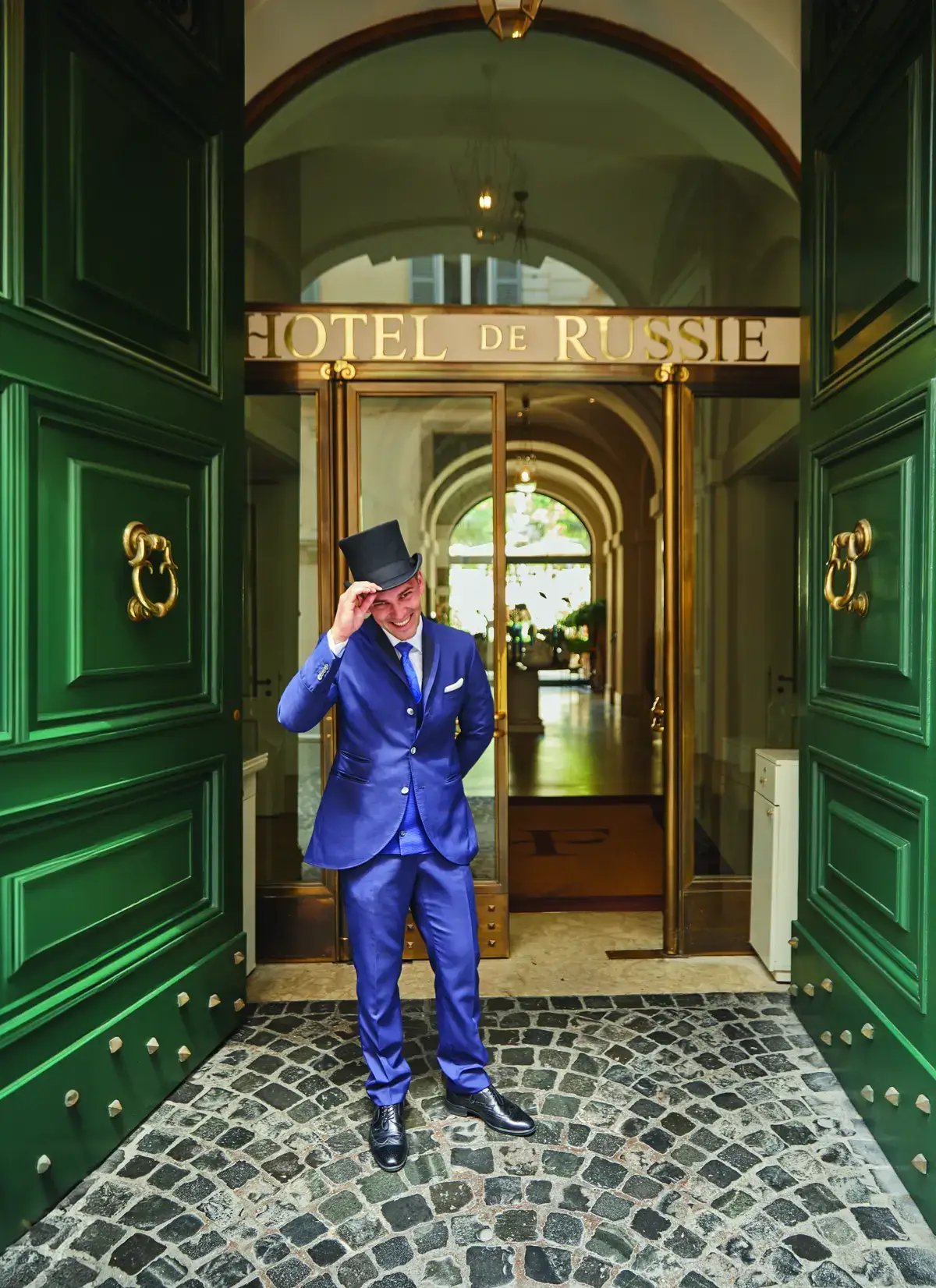
If Brown’s embodies Forte’s British heritage, Hotel de Russie is his Italian soul. Built in 1816 and revived by the Forte family after its acquisition in the late 1990s, it reopened in 2000 as a symbolic rebirth of the brand. Steps from Piazza del Popolo, long a haunt of artists like Picasso and Stravinsky, the hotel combines Roman history with contemporary clarity. Eighteenth-century Italian architect and urban planner Valadier’s terraced gardens were restored, and the interiors modernized without sacrificing the spirit of Rome.

Villa Igiea — Palermo
Once the jewel of the Florio family, Villa Igiea overlooks the Gulf of Palermo with Belle Époque grandeur. By the time Forte acquired it, the villa’s splendor had faded. Olga’s restoration revived Sicilian artisanship and preserved historical detail from frescoes and stonework to the style of the original gardens. It stands today as one of the finest examples of their philosophy and reverence for history.
Forte elaborates on their philosophy, saying, “There is now much more focus on local experiences than there was before. We are particularly good at these because of our local relationships with key people in each location. The basics have remained the same, the kindness, the will to serve and make all guests feel special have not changed.”

The Duality That Explains Everything
Forte is British in the way that matters during a crisis—steady, composed, capable of absorbing the collapse of an empire without breaking stride. When the business was taken from him, it was the stiff upper lip England had taught him that propelled him forward.
But he is also unmistakably Italian in the way he orients himself toward family and joy. He rebuilt the business with his sister at his side. Later, he welcomed his children into the company, not as symbolic heirs but as contributors with distinct strengths. Charles leads development, Lydia oversees food and beverage, and Irene, who has launched her own skincare brand, guides wellness.
“It is a joy to see them developing as well as they have, taking on more and more responsibility. I am very lucky to be able to work with them,” Forte says
There is nothing he seems to value more than working with them, watching them inhabit the world he has shaped.

The Craft That Remains
Sir Rocco Forte has lived long enough to see an empire thrive, collapse, and re-emerge in a different, more meaningful form. In an industry prone to consolidation, he remains a steward of the old craft of personal hospitality by a family-run business. He may not be the last great Old-World hotelier. But he is one of the few still practicing the craft in its classical form—personally, quietly, and with a conviction that true luxury cannot be mass-produced.