

At the top of the world, there is no horizon in the familiar sense. Ice extends in every direction, light shifts by the hour, and the Earth’s geometry becomes profoundly real. To travel here is to engage with one of the planet’s most extreme and fascinating environments. It is an experience that asks for preparation, humility, and purpose. This is the context in which PONANT EXPLORATIONS approaches the Geographic North Pole. Voyages are much more than mere passages through remote seas. Instead, they are true journeys of understanding—shaped by science, culture, and a belief that curiosity, when paired with discipline and care, deepens both knowledge and wonder.
The ship that makes it possible
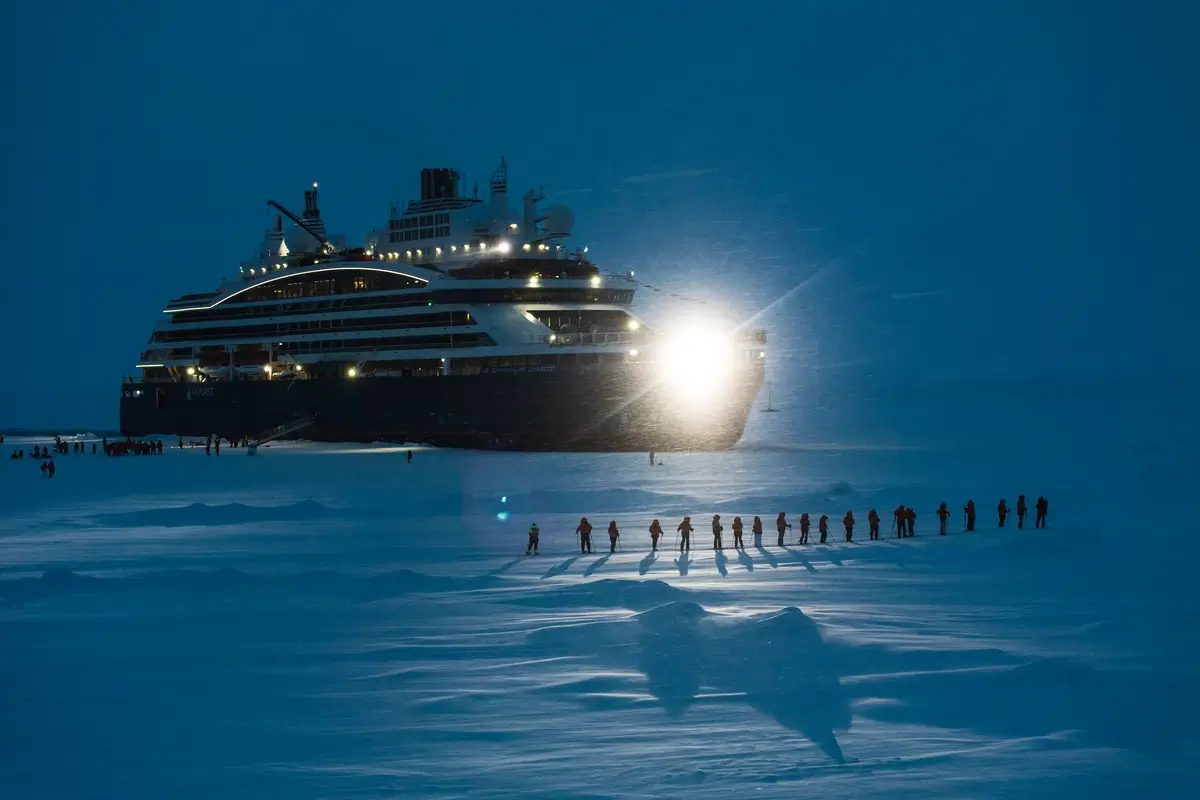
Reaching the Geographic North Pole demands more than ambition. It requires a vessel engineered to meet extreme conditions responsibly. Le Commandant Charcot, the world’s only luxury icebreaker, is designed precisely for this purpose. Powered by hybrid electric technology using liquefied natural gas, the ship represents a significant step forward in reducing the environmental footprint of polar exploration while expanding what is safely and thoughtfully achievable.
In July 2022, Le Commandant Charcot became the first luxury passenger ship to reach the Geographic North Pole. And just two years later, in September 2024, the vessel’s PC2 (Polar Class) rating enabled it to reach the North Pole of Inaccessibility—more than 1,000 kilometers (621 miles) from any landmass—marking a seminal moment in modern leisure navigation. On board, 20 international scientists conducted fieldwork supporting polar climate research, integrating data collection seamlessly into the voyage itself.

Voyages from the edge of the map to its apex
North Pole voyages with PONANT EXPLORATIONS span 12 to 17 nights, with itineraries that explore Svalbard in depth and, on select sailings, extend along Greenland’s eastern coast. Here we follow the 12-night expedition traveling roundtrip from Longyearbyen, the northernmost town on the planet. Located on the island of Spitsbergen, Longyearbyen sits at the edge of the inhabited world, where settlement gives way to the High Arctic. Glaciers spill toward the sea. Mountains stretch into an Arctic sky. Civilization thins quickly.
As Le Commandant Charcot begins to enter the permanent ice floe, the coastline reveals deeply sculpted fjords cutting into ancient rock, glaciers calving into cold, clear water, and seabird colonies animating the cliffs. Zodiac outings and landings are guided by Expedition Leaders who read the ice, weather, and wildlife conditions day by day, adapting plans with care and precision.

The vessel then turns northward as navigation becomes a dialogue with the ice itself. The pack ice is never static. Smooth plains give way to compression ridges. Fractured plates open into narrow leads of dark water and the ship advances deliberately, following nature’s cues.
Wildlife encounters—from seals and seabirds to whales and walruses—are possible but never promised. Observation is conducted at respectful distances, guided by international regulations and a clear understanding that humans are visitors here, not protagonists.
90 degrees North
The arrival at the Geographic North Pole is quiet, but charged with excitement. There is no landmark rising from the ice—only coordinates, confirmed by satellite navigation, at the intersection of every meridian on Earth. As the helicopter returns from its ice scouting mission, the anticipation builds with the Captain announcing latitude readings from the Bridge—87.6º, 88.8º, 89.5º —ultimately reaching 90º North. Guests are gathered on deck toast the moment with Champagne and caviar. Flares are launched from the heli deck as photos are snapped, hugs are exchanged, and laughter fills the Arctic air. The entire ship buzzes with the rare feeling that comes in knowing few people in history have ever come this far, or seen such wonder.

Learning as part of the journey
Life on board reflects PONANT EXPLORATIONS’ philosophy of travel as a way to connect with the natural world. Daily briefings, lectures, and informal conversations invite guests to engage deeply with what they are seeing—ice dynamics, Arctic ecosystems, exploration history, and current scientific research. Knowledge is presented as lived experience, enriched by observation and dialogue.
Throughout, flexibility remains essential. Ice and weather conditions determine routes, landings, and activities, with decisions made daily by the Captain and Expedition Leader in accordance with AECO regulations and safety protocols. In the Arctic tundra, each voyage is singular, shaped by conditions that cannot be predicted or replicated.

Le Commandant Charcot’s French sensibility brings warmth and rhythm to days shaped by ice and light. Just 245 guests are accommodated in spacious staterooms and suites—all featuring a private balcony, Diptyque Parisian amenities, Bose Bluetooth speaker, stocked minibar, a Nespresso maker, and all the indulgences of home. Cuisine emphasizes seasonality and balance. Social spaces are designed for contemplation and conversation, while the spa invites relaxation and restoration. Evenings may unfold in quiet reflection or animated discussion, shaped by the shared experience of being far from anywhere else.

Purposeful exploration
To travel to the North Pole with PONANT EXPLORATIONS is to participate in a model of exploration that values responsibility as highly as access. These voyages are not about conquest or spectacle. They are about bearing witness, contributing to understanding, and recognizing the fragility and significance of the world’s most remote regions.
At 90° North, wonder is inevitable.
For reservations or to book your voyage, contact your preferred travel advisor, or visit us.ponant.com.
