

Next-Generation Business Jet Combines Luxury and Fuel Efficiency

The super-midsize jet remains a staple of the jetset lifestyle. Large enough to accommodate a sizable party in an intimate, bespoke setting, and allowing plenty of space for retreats and relaxation, the super-mid embodies the luxury demanded by high-performance VIP travelers worldwide. Crucially, these aircraft are fast, offering impressive range. Now, the super-mid could gain a key advantage that has long eluded the business jet world: fuel efficiency.
American startup Otto Aerospace grabbed attention at the 2025 Paris Air Show with its super-mid private jet concept, the Phantom 3500. This bold entry into the super-mid market features a remarkably efficient and lightweight design that leverages the advantages of a phenomenon called laminar flow. According to Otto Aerospace, laminar flow refers to a state where air moves smoothly over a jet’s surface, allowing the aircraft to achieve exceptional aerodynamic efficiency. By maintaining this smooth airflow throughout its body, the Phantom 3500 significantly reduces drag, enabling it to fly with less energy and enhancing its overall performance in the skies.
Scott Drennan, President and Chief Operating Officer of Otto Aerospace, told Jetset that the Phantom will consume 61 percent less fuel with significantly lower carbon emissions (as much as 90 percent less with sustainable aviation fuel) without sacrificing range or cabin space. This truly sustainable aircraft will weigh approximately 19,000 pounds—nearly half the weight of some super-mids—and carry only 7,500 pounds of fuel.
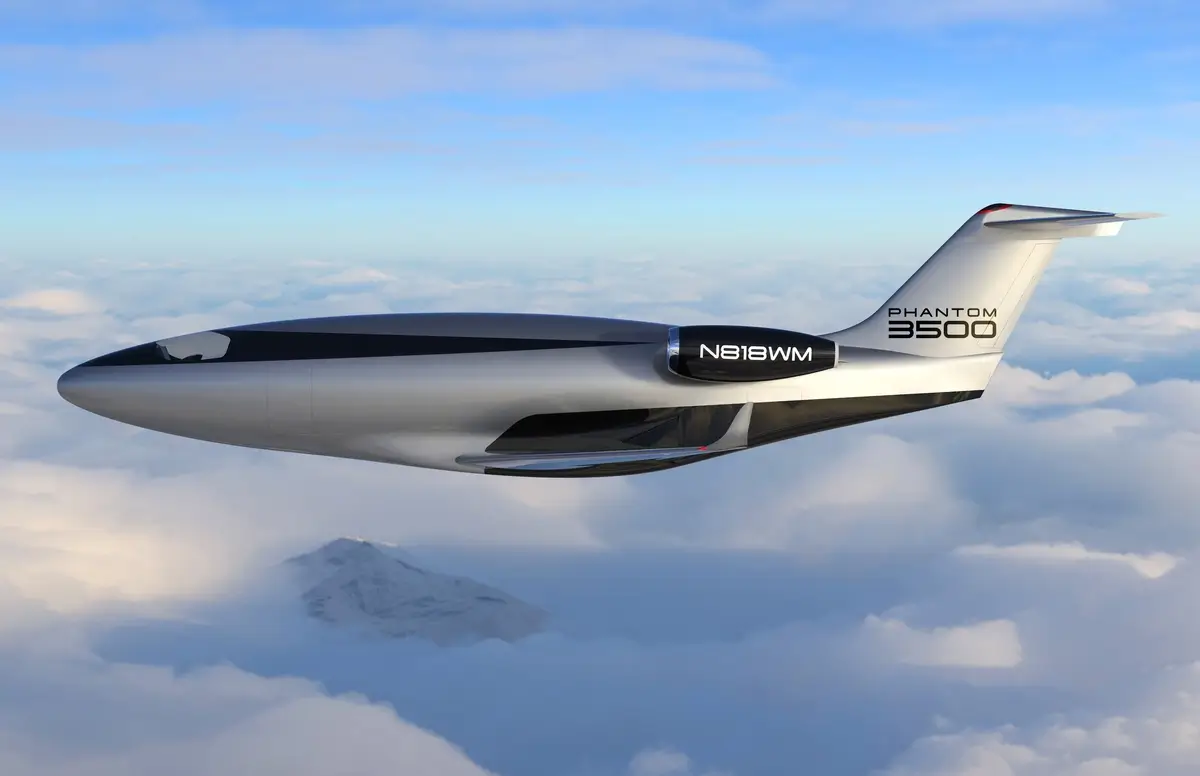
The Phantom presents an unconventional visual profile. The cockpit contains the only windows with the rest removed to promote better aerodynamics. Its fuselage showcases a teardrop design, while renderings indicate a sleek gray finish highlighted front to back by a black stripe. The long, narrow wings lend the aircraft a futuristic look, evoking an image of an orca killer whale that has sprouted wings and taken to the skies.

Its range of 4,000 miles positions well with other super-mids like the Bombardier’s Challenger 3500 with its 3,900-mile range. Moreover, the Phantom will operate at a maximum altitude of 51,000 feet, much higher than its competitors and optimal for laminar flow, according to Drennan. Powered by a pair of Williams International FJ44s jet engines, the Phantom will cut through the high atmosphere and achieve a maximum speed of over .8 Mach, or around six hundred miles per hour.
While other business jets use larger engines, the smaller Williams FJ44s engines paired with Phantom’s ability to channel laminar flow potential makes Otto’s design a true game changer. The Phantom’s takeoff weight of 19,000 pounds makes it nimbler than other super-mids, which weigh in at around 35-40,000 pounds. Lower weight translates into reduced fuel consumption, especially when combined with smaller engines and fewer components requiring maintenance and repair, Drennan explained. “This results in a more efficient aircraft overall. It turns the economics in your favor.”
Virtual Views
Unlike traditional aircraft designs that rely on cabin windows, the passengers’ view will be virtual. Small exterior cameras will capture what’s happening outside the aircraft and display it on high-definition screens in the cabin. This technology, called Super Natural Vision, will provide a “cinematic view of the world,” Drennan said.
Super Natural Vision will also double as an infotainment system. Passengers can switch between business activities such as Zoom and Outlook as well as stay up to date on the latest streamable movies and television shows. Otto is considering a touch screen interface inside the cabin to control the system. Passengers will control the system remotely with an app that will run on an operating system Otto is developing.
Inside, the Phantom offers sizable living space that accommodates up to nine passengers, with a cabin height of 6 feet 5 inches, a width of 7 feet 6 inches, and a length of twenty-three feet. In comparison, Bombardier’s Challenger 3500 has a cabin height of 6 feet, width of 7 feet 2 inches, and length of twenty-five feet. Like Bombardier’s Challenger, the Phantom can be customized, with owners and fleet operators choosing from up to four variations of the cabin or working with outside designers to fashion their own floating luxury loft.

Sustainable Future
Drennan didn’t discuss a starting price in his conversation with Jetset. However, he said the company believes that reducing operating costs and design efficiency positions the Phantom as a competitive option in the super-midsize market. One indication of the level of interest in the new aircraft is that the fractional jet ownership company Flexjet has agreed to purchase 300 Phantom 3500 jets, making the company Otto’s first fleet customer.
Otto plans to begin testing the Phantom in 2027 and aims to achieve FAA certification by 2030, when they expect to launch commercial operations. It will enter a field dominated by established manufacturers offering super-midsize jets, including the Bombardier Challenger 3500, Praetor 500, and Gulfstream G280. These aircraft, much like the Phantom, are designed to operate transcontinental at transonic speeds while accommodating nine to ten passengers.
If successful, the Phantom could offer a practical and immediate response to the challenges of carbon emissions in the business aviation space, all while providing the bespoke luxury VIPs have come to expect from business jets. Even if owners elect to use standard aviation fuel instead of sustainable aviation fuel, they can still net a 60 percent reduction in carbon footprint, Otto claims. The company is committed to achieving net-zero emissions by the time the aircraft becomes operational, well ahead of an industry-wide push for significant reductions in carbon pollution by 2050.
“It is the best short way to take the biggest chunk out of your carbon footprint, ” Drennan said.
